



Back to Top
Why Some Vapes Feel Stronger at 20mg
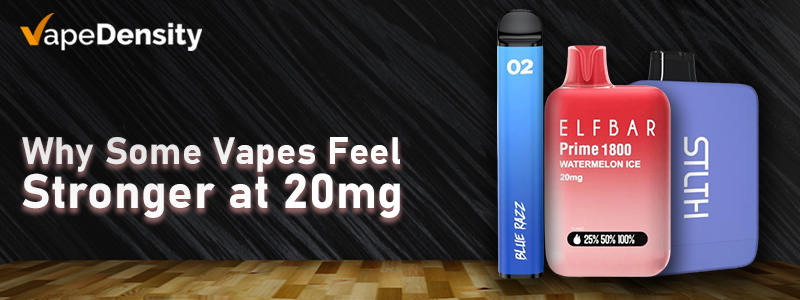
Many vapers are confused by one simple question: if two vapes both say 20mg nicotine, why does one feel noticeably stronger than the other? This experience is common, especially among users who switch devices or formats and suddenly feel a harsher throat hit or faster nicotine satisfaction without changing strength.
This article explains why some vapes feel stronger at 20mg, breaking down how nicotine is absorbed, how airflow and vapor production affect delivery and why real-world usage rarely matches label expectations.
Understanding the Confusion Around 20mg Nicotine
On paper, 20mg is 20mg. It sounds straightforward. Yet in real use, nicotine delivery is influenced by multiple factors beyond the number printed on the device or packaging. Puff style, airflow, vapor output and formulation all play a role in how quickly and intensely nicotine reaches the body.
This is why two users can vape the same strength and walk away with completely different experiences.
How Nicotine Is Absorbed
Nicotine Salts vs Freebase Nicotine
One of the biggest differences comes down to nicotine salts vs freebase nicotine.
Nicotine salts are formulated to be smoother at higher strengths and absorb more efficiently. Devices like the Elf Bar BC10K are a good example of how nic salt delivery can feel noticeably smoother compared to older freebase formats.
Freebase nicotine, on the other hand, tends to feel harsher at the same concentration and is absorbed more gradually. Devices using different nicotine formulations can therefore deliver the same 20mg in very different ways.
The result is not more nicotine, just faster or slower delivery.
Airflow and Vapor Density
How Airflow Changes Nicotine Delivery
Another major factor is vape airflow nicotine delivery. Devices with tighter airflow create a more concentrated draw. Less air mixed with vapor means each puff delivers a denser dose of nicotine.
Open airflow dilutes the vapor with more air, often making the same nicotine strength feel lighter or smoother, even though the total nicotine content remains the same.
The Role of Vapor Density
Closely related is vapor density nicotine strength. Thicker vapor carries more nicotine per puff. Devices that produce denser vapor can feel stronger simply because each inhale contains more nicotine particles.
This is why shorter, slower puffs on dense vapor devices can feel more intense than longer pulls on airy devices.
Why the Same Nicotine Can Feel Different
Why Same Nicotine Feels Different Across Devices
This brings us to the core reason why same nicotine feels different from one vape to another.
Several factors combine:
- Coil efficiency affects how evenly liquid is vaporized
- Draw resistance changes how much vapor enters the mouth
- Puff duration impacts total nicotine intake per inhale
- Device power output influences vapor temperature and density
Even personal habits matter. A user taking short, frequent puffs may absorb more nicotine than someone taking long, spaced-out draws, even at the same strength.
This is not a flaw or inconsistency. It is simply how nicotine delivery works in real-world conditions.
Usage Style Matters More Than Strength
Many users assume that stronger means higher nicotine, but that is not always true. Often, the sensation comes from how nicotine is delivered, not how much is present.
A slower draw, tighter airflow or more efficient vapor production can make 20mg feel intense, while a different setup may feel mild. Understanding this helps users adjust habits instead of assuming something is wrong with the nicotine level.
Conclusion
The reason some vapes feel stronger at 20mg has very little to do with misleading labels and everything to do with delivery mechanics. Nicotine formulation, airflow, vapor density and personal usage style all shape how nicotine feels.
Importantly, a stronger sensation does not mean higher nicotine content. It simply means nicotine is being delivered more efficiently. Once users understand this, it becomes easier to choose the right device without unnecessary confusion. If you're still figuring out what works best for you, Vape Density carries a wide range of devices suited to different draw styles and nicotine preferences.
Frequently Asked Questions (FAQs)
1. Why does one 20mg vape feel harsher than another?
Differences in airflow, vapor density and nicotine formulation can make the same strength feel harsher or smoother without changing nicotine content.
2. Does stronger throat hit mean more nicotine?
No. A stronger throat sensation usually comes from delivery style or vapor concentration, not higher nicotine strength.
3. Can puffing style change how strong a vape feels?
Yes. Short, frequent puffs or tighter draws can increase perceived strength even at the same nicotine level.
4. Is 20mg nicotine always consistent across devices?
The nicotine amount is consistent, but how efficiently it is absorbed can vary significantly between devices and usage styles.
5. Should users lower nicotine if a vape feels too strong?
Not necessarily. Adjusting airflow or puff duration often solves the issue without changing nicotine strength.
0 Comment(s)
Recent Posts
